A cell manufacturer in Ningde once told me that packaging failures rarely show up on the line — they show up three weeks later, in a warehouse in Rotterdam, when a pallet of returns comes back with crushed corners and a customer asking why 4% of the shipment arrived damaged. That conversation is a good starting point for talking about molded pulp packaging for lithium batteries, because it gets at the real question buyers and engineers care about: does this material survive the actual supply chain, not just a lab test.
Why Molded Pulp Entered This Market
Lithium cells — cylindrical (18650, 21700, 4680), pouch, and prismatic — have historically shipped in expanded polystyrene (EPS) trays or thermoformed plastic blister packs. Both work mechanically, but they carry two problems that have become harder to ignore. First, EPS is a static-prone material; friction against bare cells can generate triboelectric charge in the 1–5 kV range, which is a real concern for cells with exposed terminals or thin separator margins. Second, and increasingly the dominant issue, EU Battery Regulation (2023/1542) and extended producer responsibility rules in a growing number of jurisdictions are pushing packaging costs and reporting burdens onto non-recyclable plastic components. Molded pulp — the same fiber-based process used for egg cartons and electronics trays, but engineered for higher compression strength and dimensional tolerance — has moved from “sustainability nice-to-have” to a specified requirement in a number of RFQs from European and North American battery importers over the past two years.
The Engineering Constraints That Matter
Three properties determine whether a molded pulp tray is viable for lithium cells, and they’re worth separating clearly because suppliers often blur them together in marketing material.
Moisture regain and dielectric behavior. Cellulose fiber is hygroscopic by nature, typically equilibrating to 8–12% moisture content at 50% relative humidity. For most consumer goods that’s irrelevant. For lithium cells with exposed terminals sitting in a sealed export container that can hit 90%+ relative humidity through a tropical shipping lane, it isn’t. Reputable pulp packaging for battery applications is calendared and often coated with a water-resistant or fire-retardant sizing agent, and the dielectric strength of the dried tray — not the as-molded state — is what needs testing. A tray that measures fine at 23°C/50% RH and fails after 72 hours at 40°C/90% RH is a tray that will fail in real transit.
Compression strength under stacking load. IEC 62133-2 and UN 38.3 don’t specify packaging material, but transport testing under UN 38.3 section 38.3.4.6 (the crush and impact tests applied to cells and batteries) creates a practical requirement: the tray has to hold cell geometry rigidly enough that individual cells don’t shift, contact each other’s terminals, or experience point-loading during the vibration and drop tests carriers actually run before accepting freight. Molded pulp trays for 18650/21700 format cells generally need a wet-pressed density in the 300–450 g/m² range per cavity wall to meet a top-load requirement of roughly 15–20 kg per pallet layer without cavity collapse. Thinner, lower-density trays — the kind used for fruit packaging — will deform under stacked pallet weight over a multi-week ocean transit.
Fiber contact and outgassing. This is the point that gets least attention and probably matters most. Raw kraft pulp fiber can carry trace chloride and sulfate ions from the pulping process, and even small surface contact with a cell’s negative terminal or an exposed nickel strip over weeks of storage has been linked anecdotally (not yet the subject of a widely cited peer-reviewed study, to be direct about the limits of current evidence) to localized corrosion. Packaging suppliers serving the battery sector increasingly use bleached, low-ion pulp stock and avoid recycled fiber for the cavity-contact layer specifically because of this. If a supplier can’t tell you their pulp source and chloride ion content, that’s a legitimate question to keep asking.

Where Molded Pulp Still Loses to Plastic
It’s worth being honest about the tradeoffs rather than presenting pulp as a strict upgrade. Thermoformed PET or conductive PP trays hold tighter dimensional tolerances (±0.3mm vs. typically ±0.8–1mm for molded pulp), which matters more for automated pick-and-place assembly lines than for export packaging. Plastic trays also don’t absorb any moisture, which simplifies humidity-controlled dry-room handling during cell assembly — molded pulp is generally used downstream of the dry room, at the finished-goods packing stage, rather than inside it. And per-unit cost for molded pulp, once you account for the coating and quality-control steps needed for battery-grade fiber, typically runs 10–25% higher than commodity EPS at moderate order volumes, though that gap narrows or reverses once EPR compliance fees and disposal costs are factored in at scale.
How These Trays Are Actually Made
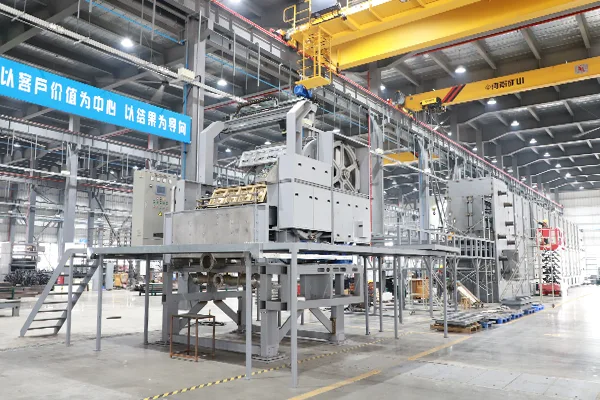
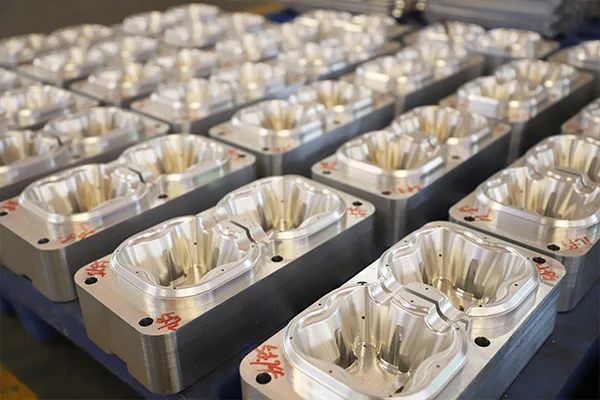
It’s worth understanding the manufacturing side too, because a lot of the tolerance and density issues described above trace back to which forming process a supplier is running. Battery-format cavity trays — with their tight nesting geometry for cylindrical cells and the wall thickness needed for compression resistance — are typically produced on reciprocating pulp molding lines rather than the high-speed rotary lines used for commodity egg trays. The reciprocating process forms one platen at a time using a combined positive/negative pressure system, which gives more consistent wall density per cavity — the exact property that determines top-load strength — at the cost of lower daily throughput than rotary equipment. That tradeoff is generally the right one for battery and electronics trays, where dimensional consistency matters more than raw unit volume.
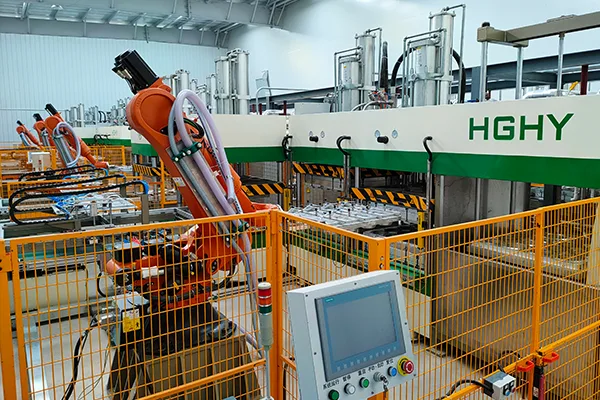
A Shockproof Packaging Making Machine is a representative example of this equipment category — it’s built specifically for shock-absorbing industrial packaging (household appliances, electronics, instruments, tools) rather than food-service trays, and the spec sheet is a useful reference point when evaluating a supplier’s capability: reciprocating forming with a metal drying tunnel, product height up to roughly 150mm, and heating options (thermal oil, natural gas, or steam) that affect both moisture uniformity in the finished tray and the fiber’s dielectric performance once cured. When qualifying a new tray supplier, it’s reasonable to ask which forming technology they run and whether it’s dedicated to industrial/shockproof geometries or shared with commodity tableware production — the two aren’t interchangeable in practice, even though both fall under “molded pulp.”

A Practical Specification Checklist
For teams evaluating suppliers, the specification sheet worth asking for includes: wet-pressed cavity wall density, moisture content at time of shipment and after 72-hour humidity conditioning, dielectric breakdown voltage post-conditioning, chloride/sulfate ion content of the fiber stock, top-load compression rating per cavity, and whether the tray has passed ISTA 3A or equivalent transit simulation with the actual cell format loaded (not an empty-tray test, which several suppliers still quote by default).
Frequently Asked Questions
Is molded pulp packaging safe for lithium-ion cells during air freight? Air freight of lithium batteries is governed primarily by IATA DGR Section II/IB packing instructions, which specify inner packaging must prevent short circuit and cushion against movement — they don’t mandate a specific material. Molded pulp trays that meet dielectric and compression specifications above are acceptable, and several major cell producers now use them for UN38.3-compliant air shipments, but the packaging as a whole (including outer carton) still needs to pass the carrier’s specific test documentation.
Can molded pulp trays be used inside a battery pack assembly, not just for transport? Generally no for structural pack components — pulp lacks the fire-retardant certification (UL94 V-0 equivalent) and long-term dimensional stability needed inside an assembled pack. Its current use is almost entirely for cell-level transport and retail packaging upstream of pack assembly.
Does molded pulp packaging affect UN38.3 test results? UN38.3 tests the cell or battery itself, not the packaging, so the tray material doesn’t change test outcomes. It does affect whether cells survive transit undamaged into the field, which is a separate but related concern.